
Załóżmy, że chcesz mieć próbkę wystarczającą do niektórych percentyli, aby nie przesadzić. Oto kod:
quantile.CI <- function(n, q, alpha=0.1) {
  #
  # Search over a small range of upper and lower order statistics for the
  # closest coverage to 1-alpha (but not less than it, if possible).
  #
  u <- qbinom(1-alpha/2, n, q) + (-2:2) + 1
  l <- qbinom(alpha/2, n, q) + (-2:2)
  u[u > n] <- Inf
  l[l < 0] <- -Inf
  coverage <- outer(l, u, function(a,b) pbinom(b-1,n,q) - pbinom(a-1,n,q))
  if (max(coverage) < 1-alpha) i <- which(coverage==max(coverage)) else
    i <- which(coverage == min(coverage[coverage >= 1-alpha]))
  i <- i[1]
  #
  # Return the order statistics and the actual coverage.
  #
  u <- rep(u, each=5)[i]
  l <- rep(l, 5)[i]
  return(list(Interval=c(l,u), Coverage=coverage[i]))
}


###bootstrap alternative method############

quantile.CI.via.bootstrap <- function(x, p, alpha = 0.1) {
  ## Purpose:
  ##   Calculate a two-sided confidence interval with confidence level of (1 - alpha) for
  ##   a quantile, based on the (computing intensive) bootstrap resampling method.
  ##
  ## Arguments:
  ##   - x: a vector of values, representing a data sample.
  ##   - p: probability cutpoint for the quantile (between 0 and 1).
  ##   - alpha: type I error level (default to 0.1 so a 90% CI is calculated)
  ##
  ## Return:
  ##   - CI: the lower and upper limits of the two-sided CI.

  q <- quantile(x, probs = p)
  message("Quantile Point Estimate = ", q, " (Probability Cutpoint = ", p, ")\n")

  ## Bootstrap resampling with 2000 replications
  library(boot)
  set.seed(1)
  b <- boot(x, function(x, i) quantile(x[i], probs = p), R = 2000)

  boot.ci(b, conf = 1 - alpha, type = c("norm", "basic", "perc", "bca"))

}
Pierwsza metoda implementuje metodę Hahn & Meeker 1991, a druga jest po prostu nieparametrycznym bootstrapem.
n.s<-seq(50,200,5)

q.90<-0.90 #less strict
q.99<-0.99
results.90<-matrix(NA,2,length(n.s))
results.99<-matrix(NA,2,length(n.s))

for (i in 1:length(n.s)){

  lu.90 <- quantile.CI(n.s[i], q.90)$Interval
  results.90[1,i]<-lu.90[1]
  results.90[2,i]<-lu.90[2]

  lu.99 <- quantile.CI(n.s[i], q.99)$Interval
  results.99[1,i]<-lu.99[1]
  results.99[2,i]<-lu.99[2]
}


plot(results.90[2,],ylab="Estimated CI limit order",xlab="n",type="l",col="blue",axes=FALSE,pch=19)
axis(2)
axis(1, at=seq_along(results.90[1,]),labels=as.character(n.s), las=2)
box()
lines(results.99[1,],col="purple",type="l",pch=18)

abline(v = which(n.s==95), col="black", lwd=3, lty=2)
# Dodaj legendę
legend(1, 175, legend=c("Dolna granica 99.", "Górna granica 90."),
       col=c("purple", "blue"), lty=1, cex=0.8)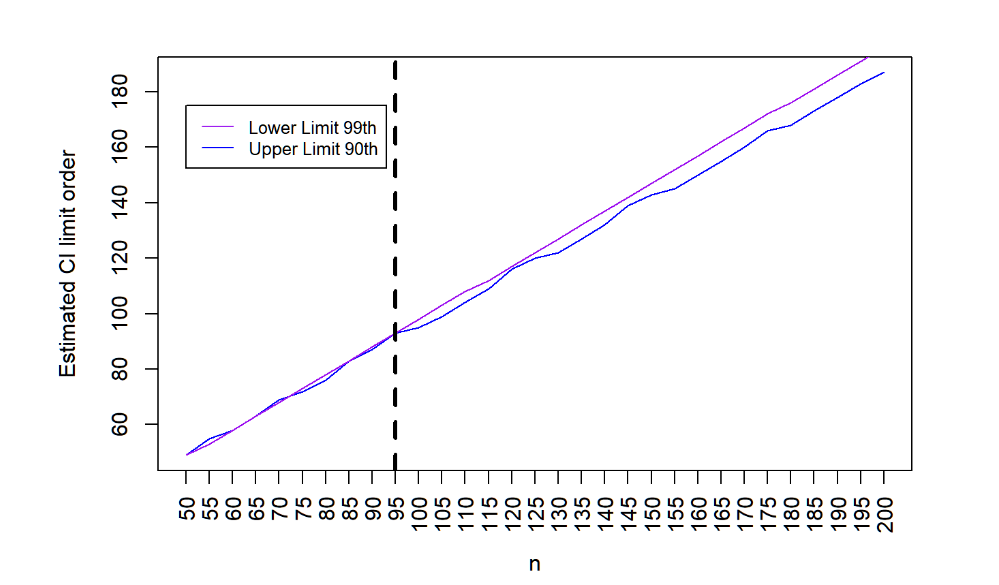
Jak widzimy, próba n=95 jest wystarczająca zgodnie z metodą bootstrap.
Wyniki Bootstrap:
n.s<-seq(50,200,5)
q.95<-0.90
q.99<-0.99
results.95<-matrix(NA,2,length(n.s))
results.99<-matrix(NA,2,length(n.s))


for (i in 1:length(n.s)){

  x <- rnorm(n.s[i], mean = which.mean.max, sd = which.sd.max) #utaj największe CV
  lu.95 <-quantile.CI.via.bootstrap(x, 0.90, 0.1)$bca
  results.95[1,i]<-lu.95[4]
  results.95[2,i]<-lu.95[5]

  lu.99 <- quantile.CI.via.bootstrap(x, 0.99, 0.1)$bca
  results.99[1,i]<-lu.99[4]
  results.99[2,i]<-lu.99[5]
}


plot(results.95[2,],ylab="Estimated CI limit",xlab="n",type="l",col="blue",axes=FALSE,pch=19,ylim=c(300,400))
axis(2)
axis(1, at=seq_along(results.95[1,]),labels=as.character(n.s), las=2)
box()
lines(results.99[1,],col="purple",type="l",pch=18)

abline(v = which(n.s==100), col="black", lwd=3, lty=2)
# Dodaj legendę
legend(1,5 , legend=c("Dolna granica 99.", "Górna granica 90."),
       col=c("purple", "blue"), lty=1, cex=0.8)
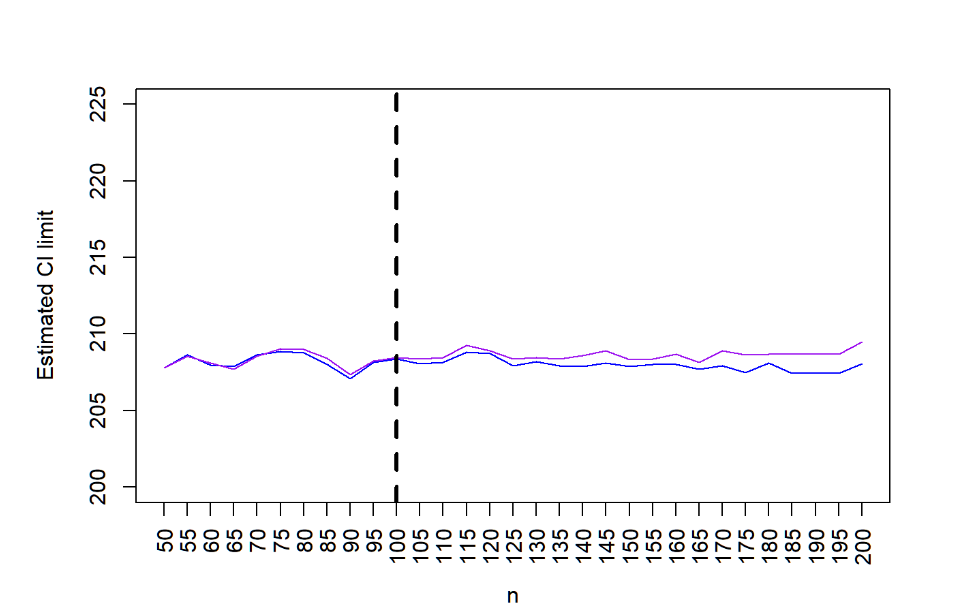
Zgodnie z wynikami boostrap 100 jest wystarczające. Należy pamiętać, że używamy tutaj szacunków typu BCA w próbkach bootrstrapowych, które są wersją odporną.
Nie, że obie metody są wolne od dystrybucji, nieparametryczne!
Można ich również użyć dla innych percentyli. Miłej zabawy!
 Polish
  English
  German
  Dutch
Dutch  Arabic
  Chinese
  Russian