
Angenommen, Sie möchten, dass die Stichprobe für einige Perzentile ausreicht, um nicht zu hoch zu liegen. Hier ist der Code:
quantile.CI <- function(n, q, alpha=0.1) {
  #
  # Search over a small range of upper and lower order statistics for the
  # closest coverage to 1-alpha (but not less than it, if possible).
  #
  u <- qbinom(1-alpha/2, n, q) + (-2:2) + 1
  l <- qbinom(alpha/2, n, q) + (-2:2)
  u[u > n] <- Inf
  l[l < 0] <- -Inf
  coverage <- outer(l, u, function(a,b) pbinom(b-1,n,q) - pbinom(a-1,n,q))
  if (max(coverage) < 1-alpha) i <- which(coverage==max(coverage)) else
    i <- which(coverage == min(coverage[coverage >= 1-alpha]))
  i <- i[1]
  #
  # Return the order statistics and the actual coverage.
  #
  u <- rep(u, each=5)[i]
  l <- rep(l, 5)[i]
  return(list(Interval=c(l,u), Coverage=coverage[i]))
}


###bootstrap alternative method############

quantile.CI.via.bootstrap <- function(x, p, alpha = 0.1) {
  ## Purpose:
  ##   Calculate a two-sided confidence interval with confidence level of (1 - alpha) for
  ##   a quantile, based on the (computing intensive) bootstrap resampling method.
  ##
  ## Arguments:
  ##   - x: a vector of values, representing a data sample.
  ##   - p: probability cutpoint for the quantile (between 0 and 1).
  ##   - alpha: type I error level (default to 0.1 so a 90% CI is calculated)
  ##
  ## Return:
  ##   - CI: the lower and upper limits of the two-sided CI.

  q <- quantile(x, probs = p)
  message("Quantile Point Estimate = ", q, " (Probability Cutpoint = ", p, ")\n")

  ## Bootstrap resampling with 2000 replications
  library(boot)
  set.seed(1)
  b <- boot(x, function(x, i) quantile(x[i], probs = p), R = 2000)

  boot.ci(b, conf = 1 - alpha, type = c("norm", "basic", "perc", "bca"))

}
Die erste Methode implementiert die Methode von Hahn & Meeker 1991 und die zweite ist lediglich ein nicht-parametrischer Bootstrap.
n.s<-seq(50,200,5)

q.90<-0.90 #los streng
q.99<-0.99
ergebnisse.90<-matrix(NA,2,length(n.s))
ergebnisse.99<-matrix(NA,2,length(n.s))

for (i in 1:length(n.s)){

  lu.90 <- quantile.CI(n.s[i], q.90)$Interval
  results.90[1,i]<-lu.90[1]
  results.90[2,i]<-lu.90[2]

  lu.99 <- quantile.CI(n.s[i], q.99)$Intervall
  results.99[1,i]<-lu.99[1]
  results.99[2,i]<-lu.99[2]
}


plot(results.90[2,],ylab="Geschätzte CI-Grenzwertreihenfolge",xlab="n",type="l",col="blue",axes=FALSE,pch=19)
axis(2)
axis(1, at=seq_along(results.90[1,]),labels=as.character(n.s), las=2)
box()
lines(results.99[1,],col="lila",type="l",pch=18)

abline(v = which(n.s==95), col="schwarz", lwd=3, lty=2)
# Hinzufügen einer Legende
legend(1, 175, legend=c("Untergrenze 99.", "Obergrenze 90."),
       col=c("lila", "blau"), lty=1, cex=0.8)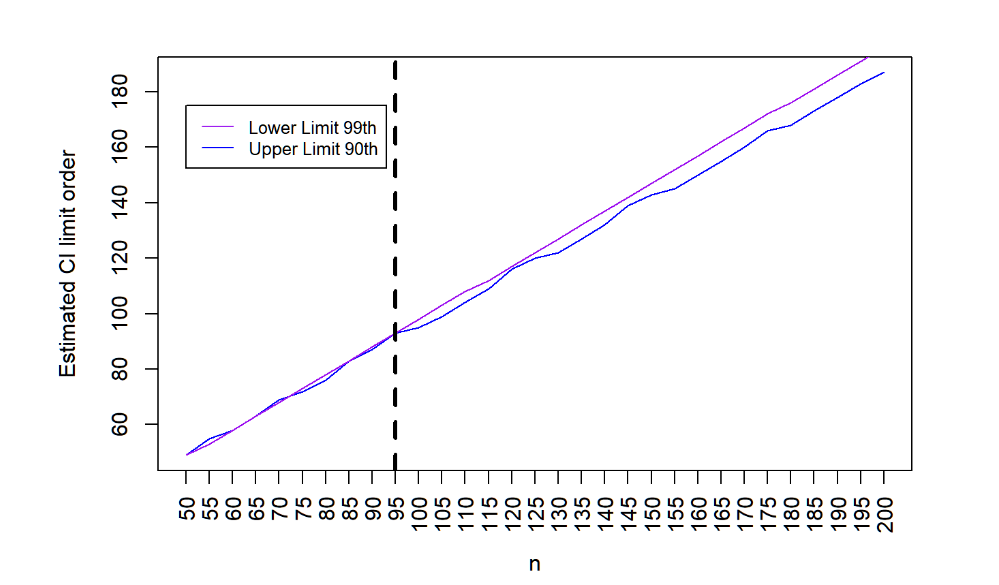
Wie wir sehen können, ist eine Stichprobe von n=95 nach der Bootstrap-Methode ausreichend.
Bootstrap-Ergebnisse:
n.s<-seq(50,200,5)
q.95<-0.90
q.99<-0.99
ergebnisse.95<-matrix(NA,2,length(n.s))
ergebnisse.99<-matrix(NA,2,länge(n.s))


for (i in 1:length(n.s)){

  x <- rnorm(n.s[i], mean = which.mean.max, sd = which.sd.max) 1TP5Hier der größte CV
  lu.95 <-quantile.CI.via.bootstrap(x, 0.90, 0.1)$bca
  results.95[1,i]<-lu.95[4]
  results.95[2,i]<-lu.95[5]

  lu.99 <- quantile.CI.via.bootstrap(x, 0.99, 0.1)$bca
  results.99[1,i]<-lu.99[4]
  results.99[2,i]<-lu.99[5]
}


plot(results.95[2,],ylab="Geschätzte CI-Grenze",xlab="n",type="l",col="blue",axes=FALSE,pch=19,ylim=c(300,400))
axis(2)
axis(1, at=seq_along(results.95[1,]),labels=as.character(n.s), las=2)
box()
lines(results.99[1,],col="lila",type="l",pch=18)

abline(v = which(n.s==100), col="schwarz", lwd=3, lty=2)
# Hinzufügen einer Legende
legend(1,5 , legend=c("Untergrenze 99.", "Obergrenze 90."),
       col=c("lila", "blau"), lty=1, cex=0.8)
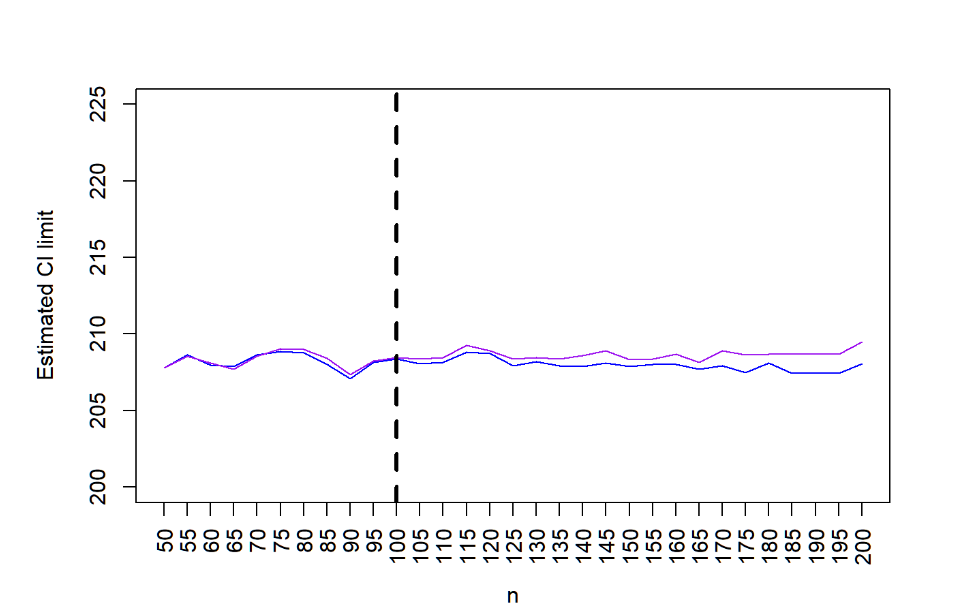
Gemäß den Boostrap-Ergebnissen sind 100 ausreichend. Beachten Sie, dass wir hier BCA-Schätzungen in einer Bootrstrap-Stichprobe verwenden, die eine robuste Version darstellt.
Nicht, dass beide Methoden verteilungsfrei, nicht parametrisch sind!
Du kannst sie auch für andere Perzentile verwenden. Viel Spaß!
 German
  English
  Polish
  Dutch
Dutch  Arabic
  Chinese
  Russian