
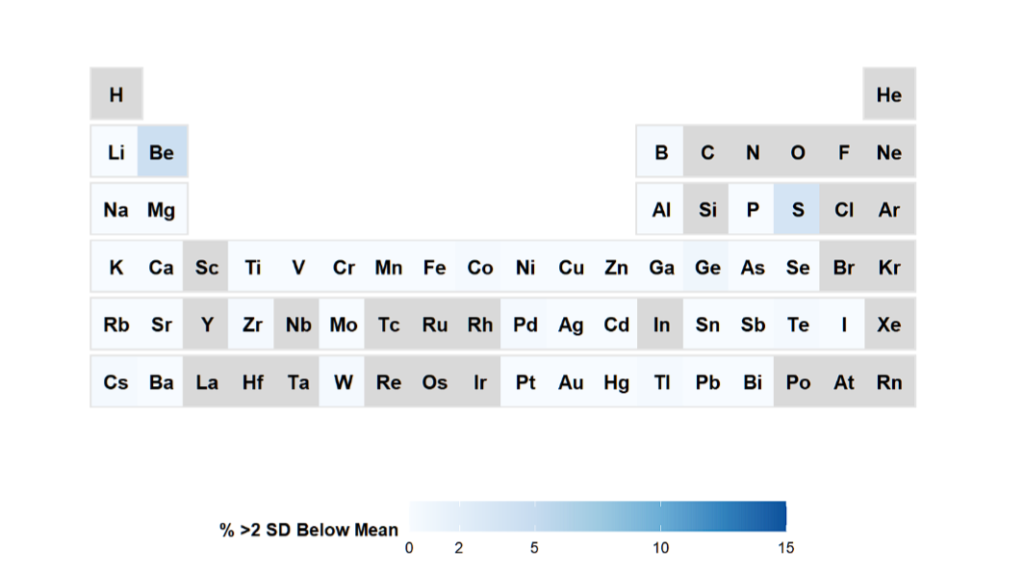
الجدول الدوري للعناصر في R؟ نعم! هذا ممكن. حتى بدون الحزمة الإضافية!
إليك الطريقة.
افترض أنك ترغب في معرفة العناصر التي يقل تركيز العناصر في بياناتك عن 2SD.
library(ggplot2)
library(dplyr)

# =============================================================================
# Step 1: Get all measured hair elements and calculate 2SD prevalence
# =============================================================================

# All potential elements (adjust based on your data)
all_elements <- c("ag", "al", "as", "au", "b", "ba", "be", "bi", "ca", "cd",
                  "co", "cr", "cs", "cu", "fe", "ga", "gd", "ge", "hg", "i",
                  "k", "li", "lu", "mg", "mn", "mo", "na", "nb", "ni", "p",
                  "pb", "pd", "pt", "rb", "s", "sb", "sc", "se", "si", "sn",
                  "sr", "te", "th", "ti", "tl", "u", "v", "w", "y", "zn", "zr")


# Calculate 2SD below mean for each element
calc_low_2sd <- function(x) {
  if(sum(!is.na(x)) >= 10) {
    mean_val <- mean(x, na.rm = TRUE)
    sd_val <- sd(x, na.rm = TRUE)
    if(sd_val > 0) {
      z_scores <- (x - mean_val) / sd_val
      n_low <- sum(z_scores < -2, na.rm = TRUE)
      pct_low <- (n_low / sum(!is.na(z_scores))) * 100
      return(pct_low)
    }
  }
  return(NA)
}

# Apply to all elements
prevalence_2sd <- data.frame(
  element = all_elements,
  pct_low = sapply(all_elements, function(e) calc_low_2sd(hair_baseline[[e]])),
  n_total = sapply(all_elements, function(e) sum(!is.na(hair_baseline[[e]])))
) %>%
  mutate(
    Symbol = paste0(toupper(substr(element, 1, 1)),
                   tolower(substr(element, 2, nchar(element))))
  ) %>%
  filter(!is.na(pct_low)) %>%
  select(Symbol, pct_low) %>%
  rename(DeficiencyPct = pct_low)

# =============================================================================
# Step 2: FULL periodic table with all elements
# =============================================================================

e_table_full <- data.frame(
  Symbol = c(
    # Period 1
    "H", "He",
    # Period 2
    "Li", "Be", "B", "C", "N", "O", "F", "Ne",
    # Period 3
    "Na", "Mg", "Al", "Si", "P", "S", "Cl", "Ar",
    # Period 4
    "K", "Ca", "Sc", "Ti", "V", "Cr", "Mn", "Fe", "Co", "Ni", "Cu", "Zn",
    "Ga", "Ge", "As", "Se", "Br", "Kr",
    # Period 5
    "Rb", "Sr", "Y", "Zr", "Nb", "Mo", "Tc", "Ru", "Rh", "Pd", "Ag", "Cd",
    "In", "Sn", "Sb", "Te", "I", "Xe",
    # Period 6
    "Cs", "Ba", "La", "Hf", "Ta", "W", "Re", "Os", "Ir", "Pt", "Au", "Hg",
    "Tl", "Pb", "Bi", "Po", "At", "Rn"
  ),
  Graph.Group = c(
    1, 18,
    1, 2, 13, 14, 15, 16, 17, 18,
    1, 2, 13, 14, 15, 16, 17, 18,
    1, 2, 3, 4, 5, 6, 7, 8, 9, 10, 11, 12, 13, 14, 15, 16, 17, 18,
    1, 2, 3, 4, 5, 6, 7, 8, 9, 10, 11, 12, 13, 14, 15, 16, 17, 18,
    1, 2, 3, 4, 5, 6, 7, 8, 9, 10, 11, 12, 13, 14, 15, 16, 17, 18
  ),
  Graph.Period = c(
    1, 1,
    2, 2, 2, 2, 2, 2, 2, 2,
    3, 3, 3, 3, 3, 3, 3, 3,
    4, 4, 4, 4, 4, 4, 4, 4, 4, 4, 4, 4, 4, 4, 4, 4, 4, 4,
    5, 5, 5, 5, 5, 5, 5, 5, 5, 5, 5, 5, 5, 5, 5, 5, 5, 5,
    6, 6, 6, 6, 6, 6, 6, 6, 6, 6, 6, 6, 6, 6, 6, 6, 6, 6
  )
)

# =============================================================================
# Step 3: Merge and plot
# =============================================================================

plot_data <- e_table_full %>%
  left_join(prevalence_2sd, by = "Symbol")

ggplot(plot_data) +
  geom_point(aes(y = Graph.Period, x = Graph.Group),
             size = 14, shape = 15, color = "gray90") +
  geom_point(aes(y = Graph.Period, x = Graph.Group, colour = DeficiencyPct),
             size = 13, shape = 15) +
  geom_text(colour = "black", size = 4, fontface = "bold",
            aes(label = Symbol, y = Graph.Period, x = Graph.Group)) +
  scale_x_continuous(breaks = seq(1, 18), limits = c(0, 19), expand = c(0,0)) +
  scale_y_continuous(trans = "reverse", breaks = seq(1, 7),
                     limits = c(7.5, -0.5), expand = c(0,0)) +
  scale_colour_gradientn(
    breaks = c(0, 2, 5, 10, 15),
    limits = c(0, 15),
    colours = c("#f7fbff", "#deebf7", "#c6dbef", "#9ecae1", "#6baed6", "#3182bd", "#08519c"),
    na.value = "grey85",
    name = "% >2 SD Below Mean"
  ) +
  labs(
    title = "Element Analysis in Your Cohort (2 SD Method)"
      )+
  theme(
    panel.grid.major = element_blank(),
    panel.grid.minor = element_blank(),
    plot.margin = unit(c(0.5, 0.5, 0, 0), "line"),
    axis.title = element_blank(),
    axis.text = element_blank(),
    axis.ticks = element_blank(),
    panel.background = element_blank(),
    plot.background = element_rect(fill="white", colour=NA),
    plot.title = element_text(hjust = 0.5, size = 14, face = "bold"),
    plot.subtitle = element_text(hjust = 0.5, size = 10, color = "grey30"),
    legend.position = "bottom",
    legend.direction = "horizontal",
    legend.key.width = unit(3, "line"),
    legend.title = element_text(size = 10, face = "bold")
  )
وما نحصل عليه هو
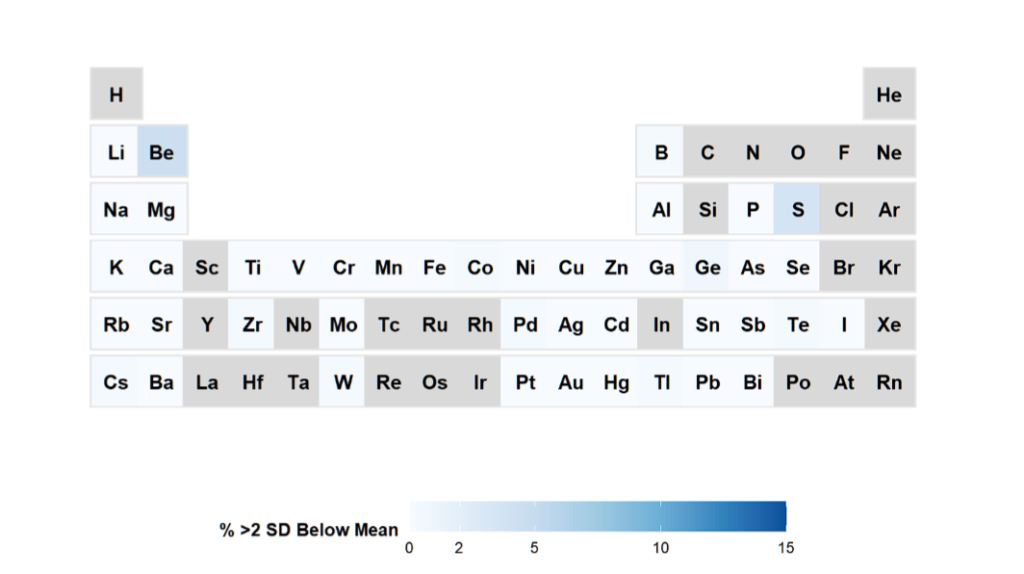
العناصر الرمادية لا يتم قياسها، والأبيض لا بأس به، والأزرق لا بأس به، مع احتمالية انخفاض المستويات. بالطبع، يمكن للمرء تحديد العتبات الخاصة بك هنا.
 Arabic
  English
  German
  Polish
  Dutch
Dutch  Chinese
  Russian